
4
The Changing Workplace
ABSTRACT. The industrial and the occupational structure of the U.S. economy changed in important ways during the decade ending in 1998. Among goods-producing sectors, only construction added jobs and the manufacturing and mining sectors both lost jobs. The service-producing sector, on the other hand, led by retail trade and business and health services, grew dramatically. The rate of growth in the numbers of individuals in four occupational groups—executive, professional, technician, and service—is projected to be more rapid than the overall rate of growth in the economy, and, consequently, their share of the workforce will increase as this trend continues. Although there are some important exceptions, the rate of occupational injuries has been higher in the declining industries such as manufacturing than in industries that are expected to continue to grow, such as retail trade. The majority of workers are now employed by small firms, and that will be increasingly true for the new jobs being created. More work will be contracted, outsourced, and part-time. Substantial numbers of workers will hold multiple jobs and will change jobs more frequently. It is anticipated that an increasing number of workers will work at home, and in some sectors there has been a decline in the number of workers represented by unions.
The committee concludes that these changes, as a whole, describe a workplace very different from the large fixed-site manufacturing plants in which occupational safety and health professionals have made the greatest strides. The changes complicate the delivery of occupational safety and health services and argue for types of training and delivery systems that are different from those that have been relied upon to date. Simply increasing the numbers or modifying the training of occupational safety and health (OSH) professionals will not be sufficient, since the primary difficulty will be access to either underserved workers or under-
served workplaces. Extensive new regulation is possible but seems unlikely. Other problems not susceptible to site- or group-specific interventions (smoking, seat belt use, and drunk driving) have been attacked with broad public education campaigns. The committee calls for systematic exploration of new models for implementing occupational health and safety programs for the full spectrum of U.S. workers.
Just as the U.S. workforce has been changing steadily in the last two to three decades, the U.S. workplace has been undergoing even more dramatic changes as the country moves away from heavy industry into the information age. Therefore, this chapter begins as the previous one did, with a short review of changes that have occurred in the recent past. As in the previous chapter, the primary source of data is the Bureau of Labor Statistics, especially its periodic data collections such as the Current Population Survey. Many of these data are directly accessible at the Bureau of Labor Statistics website (www.bls.gov/oshhome.htm), but many of the tables and figures are the result of a specific request and can be replicated only by contacting the Bureau of Labor Statistics and asking for a tabulation of the specific data in question.
REVIEW OF PAST WORKPLACE CHANGES
The workplace has changed in a number of ways that may be important both to the future workplace and to the drawing of inferences about how these changes are likely to affect the future training needs of OSH personnel. Several factors are prominent in the changing workplace. The rapid growth of the number of jobs and the greater proportion of jobs in the service sector are important changes. Another important change is the changing nature of the relationship of the worker to the workplace, in that this relationship is increasingly less permanent or long term. These changes mean that delivery of OSH training may need to be more associated with the worker and not necessarily delivered just at the workplace.
The U.S. economy has been very dynamic over the last decade with respect to the labor market. It has, for instance, continued its pattern of remarkable job growth by expanding by nearly 18 percent and adding more than 20 million jobs over the period from 1988 to 1998. Although noteworthy in itself and the envy of much of the industrial world, this dynamic growth has been accompanied by significant job market restructuring. The industrial and occupational structures of the U.S. economy are different in important ways from those of a decade earlier.
Industrial Restructuring
The U.S. economy’s expansion of the number of jobs over the last decade has not been shared equally by all industrial sectors. The numbers of jobs in some sectors have declined, whereas other sectors have shown remarkable growth not only in terms of the number of jobs but also in terms of their share of U.S. jobs (Table 4-1).
TABLE 4-1 Employment by Major Industry Division in 1988 and 1998 and Projected Employment for 2010 (numbers of employees, in millions)
|
Industry Group |
1988 |
1998 |
2010 |
|
Total |
117.8 |
138.5 |
162.8 |
|
Nonfarm wage and salary |
104.6 |
125.0 |
147.9 |
|
Goods producing |
25.1 |
25.3 |
25.3 |
|
Mining |
0.7 |
0.6 |
0.5 |
|
Construction |
5.1 |
6.0 |
6.8 |
|
Manufacturing |
19.3 |
18.7 |
18.1 |
|
Service producing |
80.6 |
100.7 |
122.6 |
|
Transportation, communication, and public utilities |
5.5 |
6.5 |
7.6 |
|
Wholesale trade |
6.0 |
6.8 |
7.8 |
|
Retail trade |
17.9 |
22.5 |
25.2 |
|
Finance, insurance, and real estate |
6.6 |
7.3 |
8.2 |
|
Services |
26.0 |
37.6 |
51.5 |
|
Personnel supply services |
1.4 |
3.2 |
4.9 |
|
Computer and data processing services |
0.7 |
1.6 |
2.8 |
|
Health services |
7.1 |
9.8 |
11.7 |
|
Offices of medical doctors |
1.2 |
1.8 |
2.8 |
|
Offices of dentists |
0.5 |
0.6 |
0.7 |
|
Offices of other health practitioners |
0.2 |
0.5 |
0.8 |
|
Nursing and personal care facilities |
1.3 |
1.8 |
2.2 |
|
Hospitals |
3.3 |
3.9 |
4.5 |
|
Social services |
1.6 |
2.6 |
3.8 |
|
Federal government |
3.0 |
2.7 |
2.6 |
|
State and local governments (including public schools) |
14.4 |
17.2 |
19.7 |
|
Agriculturea |
3.4 |
3.6 |
3.6 |
|
Private Household Workers |
1.2 |
1.0 |
0.8 |
|
Nonagricultural self employedb |
8.7 |
9.0 |
10.5 |
|
aAgriculture includes landscaping firms, which account for the increases in this sector, as the increases for landscaping firms more than offset the declines in farm employment. bThis group also includes unpaid family workers. SOURCES: Historical data are from the Bureau of Labor Statistics Survey of Nonfarm Employment, Hours, and Earnings, annual averages, selected years. Projections are by the Committee to Assess Training Needs for Occupational Safety and Health Personnel in the United States, Institute of Medicine, based on the Bureau of Labor Statistics’ projections for 1996 to 2006. |
|||
Occupational Restructuring
An important dimension of the restructuring of the U.S. economy over the past decade is the fact that the skills required in the declining and the expanding sectors are not identical, and in some cases they are very different. The restructuring of the industrial sector has therefore caused an equally dramatic change in the occupational structure of the economy.
As noted earlier, the economy added over 20 million jobs from 1988 to 1998, or an 18 percent growth. Any occupational group that expanded at a slower rate (all major occupational groups added jobs) saw its share of overall employment decline. Those occupational groups with the slowest growth and the concomitant sharpest decline in share of overall employment were agriculture, forestry, and fishing occupations and the precision production, craft, and repair occupational group, the latter of which is associated, in many instances, with manufacturing. Slower than average growth was also experienced by operators, fabricators, and laborers and also by clerical workers, groups that have seen technology lower the demand for their skills. On the other hand, very rapid growth was seen among the professional specialty and the executive, administrative, and managerial occupational groups. Marketing and sales and technician occupations also showed faster than average growth and thus saw their share of overall employment increase in the past decade. Workers in these rapidly growing occupational groups tended to be employed in very large numbers in the rapidly growing service sector (Table 4-2).
TABLE 4-2 Employment by Major Occupational Group for 1988 and 1998 and Projected Employment for 2010 (in millions of persons)
|
Occupational Group |
1988 |
1998 |
2010 |
|
Executive, administrative, and managerial |
12.1 |
14.4 |
17.5 |
|
Professional specialty occupations |
14.7 |
19.7 |
26.4 |
|
Technicians and related support occupations |
3.9 |
4.9 |
6.1 |
|
Marketing and sales occupations |
12.1 |
15.5 |
18.6 |
|
Administrative support occupations, clerical |
22.1 |
24.7 |
27.0 |
|
Service occupations |
18.4 |
22.3 |
27.8 |
|
Agriculture, forestry, fishing, and related occupations |
3.6 |
3.8 |
3.8 |
|
Precision production, craft, and repair occupations |
14.1 |
14.5 |
15.3 |
|
Operators, fabricators, and laborers |
14.1 |
18.3 |
20.2 |
|
Total |
117.8 |
138.5 |
162.8 |
|
SOURCE: Historical data are from the Bureau of Labor Statistics Occupational Employment Statistics Survey, selected years. The projections are by the Committee to Assess Training Needs for Occupational Safety and Health Personnel in the United States, Institute of Medicine, based on the Bureau of Labor Statistics’ projections for 1996 to 2006. |
|||
Given the dramatic shifts in the age, gender, racial, and ethnic compositions of the workforce discussed in the previous chapter, one might expect that this would result in prominent shifts in who holds what type of job. Although changes have taken place and in some instances this compositional change has been dramatic, many industries and occupations still employ either predominantly men or predominantly women. For example, heavy construction and mining still employ primarily men, whereas health technician jobs are mostly held by women. Also, racial and ethnic minority groups are still underrepresented in highly skilled professional and technical jobs. Furthermore, the youngest members of the workforce are most likely to enter the workforce in service industry jobs or in fast-food restaurants and family-owned farms and businesses.
The most significant story in terms of job growth in the past decade, however, has been in the service sector, which added more than 11 million jobs. Several individual industries within this sector have made significant contributions to overall job growth. These include personnel supply services (the temporary help agencies), which added more than 1.8 million jobs from 1988 to 1998. Equally important was the 1.0 million jobs added in the offices of physicians, dentists, and other health care practitioners. At the same time hospitals and nursing homes combined increased their employment by more than 1 million. Also, social service agencies added nearly 1.0 million jobs over this 10-year span. Another significant contributor to job growth was engineering and management consulting services.
A view of structural employment change over the past decade shows that employment share increased significantly only in the service sector. All other major industrial segments either retained about the same share of total employment or had declines in their share of employment (such as for manufacturing). Two important factors have strongly influenced the overall change in the structure of employment in the industrial sector of the U.S. economy. The first of these factors is the intersectoral differences in the growth of productivity. One of the reasons for the decline in employment in such sectors as manufacturing and mining, for example, is the rapid rate of growth in their productivity—particularly when it is compared with those of other industrial sectors. Conversely, the rapid employment growth in many of the service industries has been, at least in part, because of their relatively slower rate of growth in productivity.
The second factor important to intersectoral employment shifts is the shift in the structure of demand. Consumer, business, and government demand for services such as medical, educational, recreational, and computer consulting services is growing more rapidly than the demand for goods such as automobiles, televisions, stereos, and household appliances.
Factors such as globalization of trade are also important (see Chapter 5 for a discussion of this topic).
A LOOK TO THE FUTURE
The committee decided to focus on the period to 2010 to give some perspective on the future but not so far into the future that rapidly changing technology could alter in a radical way the shape of the future trends described here. Still, any look at the future must be done with due respect to possible unforeseen changes that could radically alter trends important to education and training in OSH.
The job growth in the U.S. economy over the past few decades can be expected to continue through 2010, albeit at a somewhat slower pace. This slower rate of increase reflects the demographic slowdown as the newer recruits to the labor force are drawn from a smaller birth cohort than was the case in the previous several decades. Still, the U.S. economy can be expected to add more than 24 million jobs between 1998 and 2010. However, much of the pattern that described the previous decade can be expected to continue. Therefore, by 2010 the mining, manufacturing, agricultural, and federal government sectors are expected to have fewer employees than they did in 1998. Most other sectors, including state and local governments, construction, and retail trade, can be expected to expand employment but at a rate of increase that is unlikely to increase their share of overall employment significantly and that may in a few instances result in a small decline in their share of overall employment. Thus, the service sector, which is projected to add nearly 14 million jobs, is expected to be the dominant player in terms of employment increases. Business services such as computer and data processing and personnel supply firms are expected to be prominent in this job growth picture, adding 1.7 million and 1.2 million jobs, respectively. Health services is expected to grow by 1.8 million jobs, with offices of physicians, offices of other health care practitioners, nursing and personal care facilities, and hospitals each being very important in that growth. Social service agencies are projected to add more than 1 million jobs over the period from 1998 to 2010.
Occupational Growth
Employment in all occupational groups is expected to grow, but it will be at very slow rates for occupational groups associated with sectors in which employment is projected to decline or to grow only moderately. On the other hand, employment in occupational groups associated with sectors that grow rapidly, such as health care, social services, or business services, can be expected to expand greatly. The rate of employment
growth in four occupational groups—executive, professional, technician, and service—is projected to grow more rapidly than the overall rate of growth in the U.S. economy (Table 4-2).
Occupational Injuries
Data on occupational injuries and illnesses show two important trends. First, there was a fairly steady decline in the overall rate of occupational injuries over the period from 1984 to 1997.* Second, the rate of occupational injuries is higher in the declining industries such as manufacturing and mining than it is in industries in which employment has grown and is expected to continue to grow (Table 4-3). However, this is not uniformly true. For example, construction is a growing industry, but its rate of occupational injuries, although declining, is still relatively high. Also, although in general the rate of occupational injuries is lower in the service industries, that is not the case for the health services industry, for which the rate is nearly as high as it is for construction or agriculture. Thus, although the changing industrial structure of the economy—all else being equal—should continue to lead to slightly lower overall rates of occupational injuries, there are likely to be some important exceptions. In 1997, truck drivers, those in construction-related occupations, and those in health occupations had among the largest numbers of nonfatal occupational injuries and illnesses (Figure 4-1). Employment in all three of these sectors is projected to grow substantially.
A Census of Fatal Occupational Injuries has been conducted and published by the Bureau of Labor Statistics since 1992 (Table 4-4). Each year between 1992 and 1998 has witnessed more than 6,000 fatal occupational injuries. Although the rate of fatal injuries has declined over this time period, the decline has been a very gradual one and largely one that has been due to an increase in the number of workers rather than a decrease in the number of deaths. More than 40 percent are transportation-related accidents. Assaults and violent acts are responsible for about 16 percent of occupational fatalities, as is contact with objects. Truck drivers, those in
TABLE 4-3 Incidence of Nonfatal Occupational Injuries and Illnesses by Private Industry Division, Selected Years
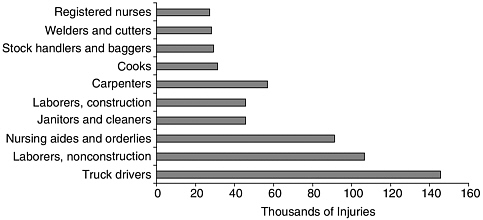
FIGURE 4-1 Occupations with the highest number of nonfatal occupational injuries and illnesses, 1997. Rates are not shown because the data on the number of hours worked by occupation, which are necessary for calculation of rates, are unavailable. SOURCE: Bureau of Labor Statistics (1998a).
TABLE 4-4 Fatal Occupational Injuries, 1992 to 1998, in Private Industry and Government
|
Year |
No. |
Rate* |
|
1992 |
6,217 |
5.0 |
|
1993 |
6,331 |
5.0 |
|
1994 |
6,632 |
5.0 |
|
1995 |
6,275 |
5.0 |
|
1996 |
6,202 |
4.8 |
|
1997 |
6,218 |
4.7 |
|
1998 |
6,026 |
4.5 |
|
*Rate of fatal occupational injuries per 100,000 workers, civilian, age 16 and older. SOURCE: Bureau of Labor Statistics (1999b). |
||
farm occupations, those in sales occupations, and construction laborers have the largest numbers of fatal occupational injuries. Men are more likely to suffer fatal occupational injuries, as are the self-employed.
Another perspective on injuries can be obtained from the report Reducing the Burden of Injury (Institute of Medicine, 1999). That report shows that injuries (from all sources, not just occupational) have a higher cost, measured either in dollars or in years of potential life lost, than many chronic diseases such as cancer, heart disease, or human immunodeficiency virus infection.
Union Membership
The percentage of the workforce that is unionized has been declining for many decades (Table 4-5). That decline is true not only for the total workforce but also for all major sectors of the economy except the public sector. Inasmuch as unions have been an important source of advocacy for worker protection programs and OSH training, the decline in the unionized share of the workforce diminishes the reach of this means of worker training. Unions have recently responded to this decline by increasing their efforts to organize workers, in the health care and public sectors and among temporary workers in particular.
Contingent and Alternative Employment Arrangements
The workplace has been transformed in other ways that may have important implications for the training of safety and health personnel in the future. One of these is the rise of an industry called personnel supply
TABLE 4-5 Percentage of Workforce That Is Unionized by Major Sector, Selected Years, 1983 to 1998
|
Sector |
1983 |
1985 |
1990a |
1995b |
1998 |
|
Total |
20.1 |
18.0 |
16.0 |
14.9 |
13.9 |
|
Mining |
20.3 |
17.3 |
17.9 |
13.8 |
12.2 |
|
Construction |
27.5 |
22.3 |
20.6 |
17.7 |
17.8 |
|
Manufacturing |
27.8 |
24.8 |
20.5 |
17.6 |
15.8 |
|
Transportation and public utilities |
42.4 |
37.0 |
31.5 |
27.3 |
25.8 |
|
Services |
7.7 |
6.6 |
5.8 |
5.7 |
5.6 |
|
Government |
36.7 |
35.8 |
36.4 |
37.8 |
37.5 |
|
aAdjusted to 1990 population controls. bBeginning in 1994, data are not strictly comparable to those from earlier years because of the 1994 revisions in the Current Population Survey. SOURCES: Bureau of Labor Statistics, Current Population Survey, annual averages, selected years. |
|||||
services or, more commonly, temporary help. Other increasingly common workers whose employment situation deviates from the traditional employer-employee relationship are contingent workers, independent contractors, and on-call workers.
Temporary Help Agencies
As can be seen in Figure 4-2, the temporary help (personnel supply service) industry grew from 990,000 employees in 1986 to more than 3.2
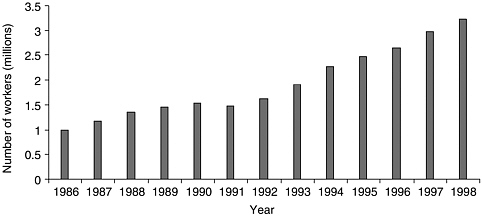
FIGURE 4-2 Employment in personnel supply services, 1986 to 1998 (wage and salary workers in millions). SOURCE: Bureau of Labor Statistics (1998c).
million employed by 1998. This growing industry is one measure of the changing job market, in that many employees are now working for an agency that places them with firms with which there is little expectation of any long-term relationship.
Contingent Workers
The emerging phenomenon of temporary jobs is also exemplified through contingent work. In a survey conducted by the Bureau of the Census for the Bureau of Labor Statistics (Bureau of Labor Statistics, 1995), a contingent worker was defined as one who did not have an implicit or explicit contract for ongoing work. In that survey, three slightly different definitions of contingent work were used, yielding a February 1995 range of estimates of contingent workers from a low of 2.2 percent of all workers to a high of 4.9 percent. The survey revealed that contingent workers were more likely to be young, to be in school, to hold a part-time job, or to be employed in the service industry. Even in the service industry, they represented only a very small proportion of total employment (3.4 to 7.5 percent).
Independent Contractors
The Bureau of Labor Statistics defines independent contractors as wage and salary employees (i.e., not business operators such as shop owners and restaurateurs). The February 1995 survey (Bureau of Labor Statistics, 1995) found that 8.3 million workers (6.7 percent of all employed individuals) said they were independent contractors. Compared with workers in traditional employment arrangements, independent contractors were more likely to be male, white, over 24 years old, out of school, and holders of a college degree. They were somewhat more likely to work part-time and to hold managerial, professional, sales, or precision production jobs. They were more likely to work in construction, agriculture, and services, and were somewhat less likely to be employed in wholesale or retail trade. In contrast to on-call workers and workers employed by temporary help agencies, who generally preferred to be in traditional work arrangements, more than 80 percent of independent contractors preferred their current arrangement.
On-Call Workers
Substitute teachers and construction workers are examples of still another category of employees with alternative employment arrangements. These are people in a pool of workers who are only called to work
as needed, although they may be called to work for several days or weeks at a time. Two million workers (1.7 percent of all employed individuals) classified themselves this way in 1995 (Bureau of Labor Statistics, 1995). The demographics of this group, which includes day laborers, were similar to those of workers in traditional employment arrangements, although the on-call group was slightly younger. On-call workers were more likely to be in the services industry and were more than three times as likely to be in the construction industry.
Work at Home
The workplace is changing in another important way, in that for a growing segment of the workforce the workplace is now their home. In addition, many other workers take home work from their regular place of work. A special survey done in May 1997 showed that over 21 million workers reported that they work at home (Bureau of Labor Statistics, 1998d). The survey showed much higher at-home rates of employment for those in white-collar occupations such as professionals and sales workers than for those in blue-collar occupations such as craft workers. As a series of investigations into at-home assembly of electronic components in California’s Silicon Valley (Ewell and Ha, 1999) have revealed, however, such arrangements can encourage exploitation of low-paid manual workers by hiding violations of labor and safety laws. Also, the at-home employment rate was higher for those in the service industry, real estate, and wholesale trade. Although this one-time survey does not give trends, every expectation is that the phenomenon of working at home will grow and will further complicate the implementation of OSH programs and enforcement of Occupational Safety and Health Administration (OSHA) standards by putting the workplace in a location that most Americans consider most private.
Number of Jobs in a Lifetime
As the workplace changes in many different ways, one of the common assumptions is that most workers will have many jobs over the course of their working lives. However, it is not possible to track this development by use of data from the sample surveys used for most of the large data collection efforts. It is necessary to follow the same workers through time through the use of what is termed a “longitudinal database.” Such a database has tracked a sample of workers from 1978 to 1995, following them from age 18 to age 32.
Although the data in Figure 4-3 do not answer the question of whether this phenomenon is growing, it does show that workers have had a large
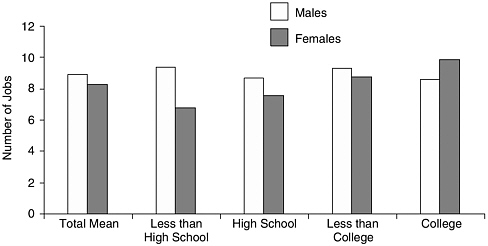
FIGURE 4-3 Mean number of jobs held between the ages of 18 and 32 (1978 to 1995) reported in 1995 by individuals ages 31 to 38 in 1995, by level of education.
SOURCE: Bureau of Labor Statistics (1998e).
number of jobs by age 32. However, most of these jobs have taken place by age 22. Women have more jobs with increasing educational levels, whereas the pattern for men by level of education is less clear. The committee’s prediction is that these patterns will continue to be characteristic of youth entering the labor market.
Multiple Jobs
The proportion of people who hold multiple jobs has increased gradually from 5.2 to 6.2 percent of job holders over the last two decades. However, the rate of multiple-job holding has gradually been declining among men but has been increasing rapidly among women. In the latest data women represent nearly 44 percent of those who hold multiple jobs, although in 1970 they represented less than 16 percent (Stinson, 1997).
Part-Time Workers
Another workplace change is the share of the workforce that is working in part-time jobs. Although in earlier periods part-time work had grown as a share of employment, in the last few years it seems to have leveled off (Table 4-6). This may in part be related to the fact that in the 1990s the economy was operating at a much higher capacity. In 1998, 25.9 percent of women were employed part-time, whereas 10.6 percent of men were employed part-time.
TABLE 4-6 Employed Persons by Full- or Part-Time Status, 1970 to 1998
|
|
Percentage of All Workers |
||
|
Year |
Full-Time |
Part-Time |
Part-Time for Economic Reasons* |
|
1970 |
84.8 |
15.2 |
3.1 |
|
1975 |
83.4 |
16.6 |
4.4 |
|
1980 |
83.1 |
16.9 |
4.4 |
|
1985 |
82.6 |
17.4 |
5.2 |
|
1990 |
83.1 |
16.9 |
4.4 |
|
1995 |
81.4 |
18.6 |
3.6 |
|
1996 |
81.7 |
18.3 |
3.4 |
|
1997 |
82.1 |
17.9 |
3.1 |
|
1998 |
82.3 |
17.7 |
2.8 |
|
*Those who want full-time work but who are unable to find a job. Part-time is defined as <35 hours a week. SOURCE: Bureau of Labor Statistics, Current Population Survey, annual averages, selected years. |
|||
Employment by Size of Employer
An important way of reviewing the dynamics of the U.S. workplace is by an examination of the size of the workplace in terms of number of employees. This measurement can be made in two different ways: at the firm (or total company) level or at the establishment (or individual plant or office site) level. The Small Business Administration maintains a database that is helpful for measuring employment at the firm level. These data show that in 1996, 48 percent of employed people were employed by firms with more than 500 employees. Of the 52 percent who were employed by firms with less than 500 employees, nearly 20 percent were employed by firms with less than 20 employees. More importantly, the dynamics of change are moving employees from the larger to smaller firms. For example, from 1990 to 1995, 1.8 million firms were founded and survived until 1995 (Figure 4-4). However, over the same period, 1.5 million firms that existed in 1990 had failed by 1995, leaving a net addition of more than 250,000 new firms. This added 1.5 million jobs (22 percent of total jobs added over this period), and continuing firms accounted for an additional 5.4 million new jobs. Of these 6.9 million net new jobs created from 1990 to 1995, firms with less than 500 employees provided 76.5 percent of those jobs, and the very small firms (those with less than 20 employees) created nearly one-half of the total (49.5 percent).
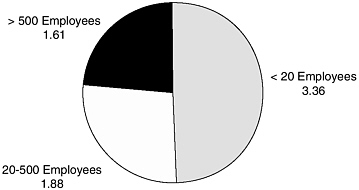
FIGURE 4-4 Aggregate employment increase (in millions) between 1990 and 1995 for firms of various sizes. SOURCE: Small Business Administration, Office of Advocacy (1998).
A review of the net new jobs by sector reveals that of the 6.9 million net new jobs added between 1990 and 1995, 5.8 million were in services, with jobs in health care accounting for more than 2.0 million of that total. In the overall service category, 62 percent of the net new jobs were in firms with less than 500 employees, and 29 percent were in firms with less than 20 employees. However, the split of jobs added in health care services was nearly evenly divided between those firms with less than 500 employees and those with more than 500 employees Additionally, the very small health care services firms provided only 15 percent of the net new jobs from 1990 to 1995.
The Bureau of Labor Statistics also has a database that allows an examination of the numbers of employees at the establishment level. These data are shown in Table 4-7. Large establishments (those with more than 1,000 employees) showed very large decreases in their share of employees between 1980 and 1997. By 1997 less than one in eight workers was employed by an establishment with more than 1,000 workers. This decline has been offset by growth in the share of employees in small establishments, with the largest changes taking place in establishments with 20 to 49 employees and those with 100 to 249 employees. However, with the exception of the very smallest establishments, some increases have taken place in all establishments with less than 250 employees. Some of this shift to smaller establishments reflects the movement of employment from manufacturing to services.
This examination of the dynamics of job creation and the role of small firms in the job creation picture shows that the idea of placing specially trained OSH personnel in firms is probably feasible for only the small
TABLE 4-7 Employment by Size of Establishment in Selected Years, 1980 to 1997
|
Number of Employees |
Percentage of All Private Jobs |
||||
|
1980 |
1985 |
1990 |
1995 |
1997 |
|
|
<5 |
4.6a |
6.6 |
6.3 |
6.7 |
6.6 |
|
5–9 |
9.1b |
7.7 |
7.8 |
8.5 |
8.3 |
|
10–19 |
9.2 |
9.7 |
9.9 |
10.9 |
10.8 |
|
20–49 |
14.1 |
14.9 |
15.1 |
16.5 |
16.7 |
|
50–99 |
11.4 |
12.3 |
12.3 |
12.9 |
12.9 |
|
100–249 |
14.4 |
15.2 |
15.8 |
16.2 |
16.4 |
|
250–499 |
9.9 |
9.7 |
9.8 |
9.3 |
9.5 |
|
500–999 |
8.6 |
7.8 |
7.9 |
7.1 |
7.2 |
|
>1,000 |
18.8 |
15.8 |
15.2 |
11.8 |
11.7 |
|
aFor 1980 only, this category is less than four employees. bFor 1980 only, this category is four to nine employees. SOURCE: Bureau of Labor Statistics (1998c). |
|||||
percentage of firms that are very large (and these have declining shares of total employment). Even among establishments, an increasing share of total employment is found in smaller establishments and a declining share is found in establishments with more than 250 employees, with rapidly declining shares found in the largest plants or offices.
IMPLICATIONS FOR OCCUPATIONAL FATALITIES, INJURIES, AND ILLNESSES
Many changes have taken place in the workplace over the last few decades, and many changes are projected in the future. For this report the question is what these changes imply for occupational fatalities, injuries, and illnesses, the implementation of workplace safety and health programs, and for the education and training of OSH personnel.
As seen in Table 4-3, the rate of occupational injuries is high in many industries with declining numbers of employees such as manufacturing and mining. At the same time, in many industries with expanding numbers of employees the injury and illness rates are low. However, there are important exceptions to these broad trends. Construction, an industry with relatively high injury rates, is an industry projected to continue to grow in terms of numbers of workers. Furthermore, the health service industry, unlike many of the other service industries, has an injury rate
nearly as high as that of the construction industry or some of the manufacturing industries. This same pattern carries over into specific occupations, where nursing aides have injury rates nearly as high as those of construction workers or some of the production workers in manufacturing and mining. Workers in other occupations that are projected to grow rapidly and that also have particularly high rates of injury or illness include truck drivers, cashiers, and carpenters. Also, the number of upper-extremity strain injuries has been increasing and is particularly high among those in several other occupations expected to grow rapidly such as dental hygienists and meat cutters (Leigh and Miller, 1998). Nevertheless, many other occupations that are found in the service industries and that are also projected to grow have very low rates of injury and illness.
Beyond the changing industrial and occupational structure, many other workplace changes have been discussed in this chapter. More workers are employed by small firms, and that is increasingly true of the new jobs being created. More work is part-time, particularly for women. More workers hold multiple jobs. Some workers now work at home, and a smaller percentage of workers are represented by unions. These changes as a whole describe a significantly changing workplace, one very different from the large fixed-site manufacturing plants with unionized workers in which OSH professionals have made their greatest contributions. Unfortunately, there are not enough comprehensive data to determine if this implies lower or higher rates of occupational injuries and illnesses for the workforce as a whole. However, it is clear that these changes will make it more difficult to identify putative causes of injuries and illnesses across an individual’s work history and generally provide OSH services to workers.
IMPLICATIONS FOR TRAINING NEEDS OF OCCUPATIONAL SAFETY AND HEALTH PERSONNEL
The review in this chapter has noted a number of changes in the industrial and occupational structures of the U.S. economy. Also, the nature of the jobs held by many people has been changing in that the job is more likely to be with a temporary help agency and to be one of multiple jobs for the jobholder. It is also somewhat less likely to be in an industry with a high rate of occupational injury or illness. Furthermore, the dynamics of employment change show that great movement of jobs takes place each year as firms are founded, survive and grow, or fail. This leads to a great deal of movement of workers from one workplace to another. Many of these changes complicate the implementation of workplace safety and health programs, raising the questions of how and where OSH services are best delivered. It may even be necessary to focus delivery of
OSH training directly on the workers. In any case, it argues for types of training and, in particular, delivery systems different from those that have been relied upon to date. For example, a knowledge of and a willingness to work with mass media may be required to reach workers at home as well as at work.
It has always been the case that a large fraction of the U.S. workforce has been outside the sphere of influence of OSH professionals, particularly those professionals who focus on injury and illness prevention. This has principally been because OSH services are most often employed in midsize to large industries and workplaces, but it is also because, in some sectors of the economy, both the workplace and the workforce are transient. If the occupational etiology of workplace illness or injury for most of these workers is recognized, it typically has few consequences beyond the immediate issue of who pays for the medical services that the workers may receive. Neither the elements of clinical case management that relate to an expeditious return to work nor the prevention programs that relate to hazard management and the prevention of reinjury or injury to others exposed to similar risks can be deployed. That is, these workers simply become part of the larger public health problem without reference to or benefit from an understanding of the occupational character of their condition. Some recent efforts by OSHA to reach out to workers like these and to small businesses in general are discussed in Chapter 7.
As has been documented in this chapter, there is considerable evidence that the number of workers outside the sphere of influence of OSH professionals is growing significantly. Simply increasing the numbers or modifying the training of OSH professionals will not be sufficient to address the issue since there is no institutional infrastructure that allows these professionals access to either underserved workers or underserved workplaces. The two principal strategies used to deal more generally with other environmental health problems that are not susceptible to site- or group-specific interventions have been government regulation and public education.
The first of these strategies, government regulation, is represented by OSHA standards. As noted in Chapter 1, there are well over 100 OSHA standards that govern workplace health and safety. There are only 2,488 federal and state OSHA inspectors responsible for enforcing the law at nearly 7 million workplaces (Occupational Safety and Health Administration, 2000). In fiscal year 1999, the 1,242 federal OSHA inspectors conducted 34,342 inspections and the state OSH inspectors combined conducted 54,989 inspections. Two-thirds of these inspections involved construction or manufacturing sites, and the average penalty for the 280,000 violations uncovered was less than $500. These figures represent a decrease of 23 percent in federal inspections and 7 percent in state
inspections since fiscal year 1994. The dramatic increase in the $382 million OSHA budget that would be necessary to make inspection a credible deterrent at all 7 million work-sites does not appear likely.
OSHA is nevertheless currently soliciting comments on a draft proposed safety and health program rule that would require all employers except those in construction and agriculture to set up a safety and health program appropriate to the hazards to which their employees are exposed and the number of employees exposed. A model widely used in Europe and Asia goes even further by requiring industry to employ health and safety professionals on the basis of the size and nature of the company. One could take this approach so far as to have the government employ the health and safety professionals and assign them to various industries, as is the Scandinavian practice. Adoption of either of these European models seems highly unlikely given the substantial philosophical, social, and political differences between Europe and the United States. Even the adoption of OSHA’s proposed safety and health program rule is far from assured. Given realistic resource forecasts and the contentious nature of regulatory innovation, it is not likely that a traditional regulatory approach will, by itself, succeed in producing a major increase in demand for OSH programs in the heretofore underserved sectors of the U.S. economy. OSHA, in fact, is increasingly focusing on “outreach” programs that provide consultation and training to small business. Some of those efforts are described in Chapter 7.
A more modest and more feasible goal might focus on modification of the many existing standards that include mandates for worker training. Few of these standards say anything about quantity, quality, or efficacy, and as a result, they have had only limited success ensuring effective health and safety training in small workplaces and of the transient workforce. An exception may be that demand for OSHA-mandated worker education, exemplified by the 10-hour general industry and construction safety training courses, has grown dramatically as contractors and owners have included such requirements for hiring of workers or receiving a contract. There is also some precedent for requiring training of managers in federal safety standards. Environmental Protection Agency lead and asbestos abatement training standards, for example, require that supervisors receive the same training as workers, plus some additional training commensurate with their additional responsibilities. A large-scale demonstration project that focuses on high-quality training and evaluation of effectiveness could provide a model and an impetus for expanded worker training programs to meet the needs of the growing workforce underserved by OSH professionals.
The second type of strategy that has been effective in public health, and which is by no means incompatible with broader or more strictly
enforced regulation, has used broadly focused educational campaigns carried out through print and electronic media. Examples include promotion of automobile seat belt use, discouraging driving after drinking, promoting healthier eating habits, and decreasing tobacco consumption. To some extent, this strategy is difficult to translate to OSH because it depends for its success on very simple and very general messages; for example, if you use your seat-belt you are less likely to die in a collision, drinking and driving greatly increase your risk of injury or death, or eating lots of fruits and vegetables will decrease your cancer risk. Occupational injury and disease, however, are extraordinarily diverse in their etiologies, and therefore the nature of effective interventions is also diverse, limiting the effectiveness of educational approaches carried out through mass media. Nevertheless, because of the limited mechanisms for reaching those workers who cannot be accessed through midsize to large employers, OSH campaigns in the media should be given renewed attention, perhaps supplemented by the Internet as a means of dealing with the diversity of the messages to be delivered.
If regulation-driven worker education and more focused public education campaigns are deemed a priority in the future as a response to the changes in the workplace that have been outlined in this chapter, increasing demand for specialists in OSH will follow not only in the private sector but also in the public sector, union-based organizations, and academia.


